News
23/09/2026
Our Heat Pump Test Facility is Ready for Experimental Testing
Following the completion of the hydraulic and electrical connections, our experimental heat pump testing facility has now entered its operational phase.
The climatic chamber has been started up and the air-to-water heat pump under test has been successfully coupled with the experimental hydraulic line and the controlled climatic environment in which the unit is installed.
The facility allows us to reproduce different outdoor conditions and evaluate heat pump performance under controlled laboratory conditions, in both heating (winter) and cooling (summer) operating modes.
The test facility is now ready to support experimental campaigns on different heat pump units across a wide range of climatic conditions, including dynamic temperature profiles. This enables the investigation of heat pump behaviour not only under steady-state conditions, but also under variable and more realistic operating conditions.
The experimental heat pump testing facility has been developed through the HYBRHEAT – Advanced Control Strategies for Hybrid Heat Generation project, selected for funding under the Fondazione VRT – Energy Transition 2024 call. The project is led by Dr. Vittoria Benedetti at the Department of Civil, Environmental and Mechanical Engineering (DICAM), University of Trento.
27/07/2026
Preparing Our Heat Pump Test Facility for New Experimental Campaigns
Our laboratory is currently completing the final hydraulic and electrical connections between the climatic chamber and the experimental heat pump testing line, preparing the facility for a new series of experimental activities.
The test rig is equipped with an air-to-water heat pump that will be used to evaluate system performance under controlled laboratory conditions.
The experimental campaign will include both heating (winter) and cooling (summer) operating modes, providing reliable experimental data for the assessment, validation, and optimization of heat pump technologies.
The facility will support future research activities focused on high-efficiency HVAC systems and experimental performance evaluation.
The development of the experimental heat pump testing facility has been made possible through the HYBRHEAT – Advanced Control Strategies for Hybrid Heat Generation project, selected for funding under the Fondazione VRT – Energy Transition 2024 call. The project is led by Dr. Vittoria Benedetti at the Department of Civil, Environmental and Mechanical Engineering (DICAM), University of Trento.
25/05/2026
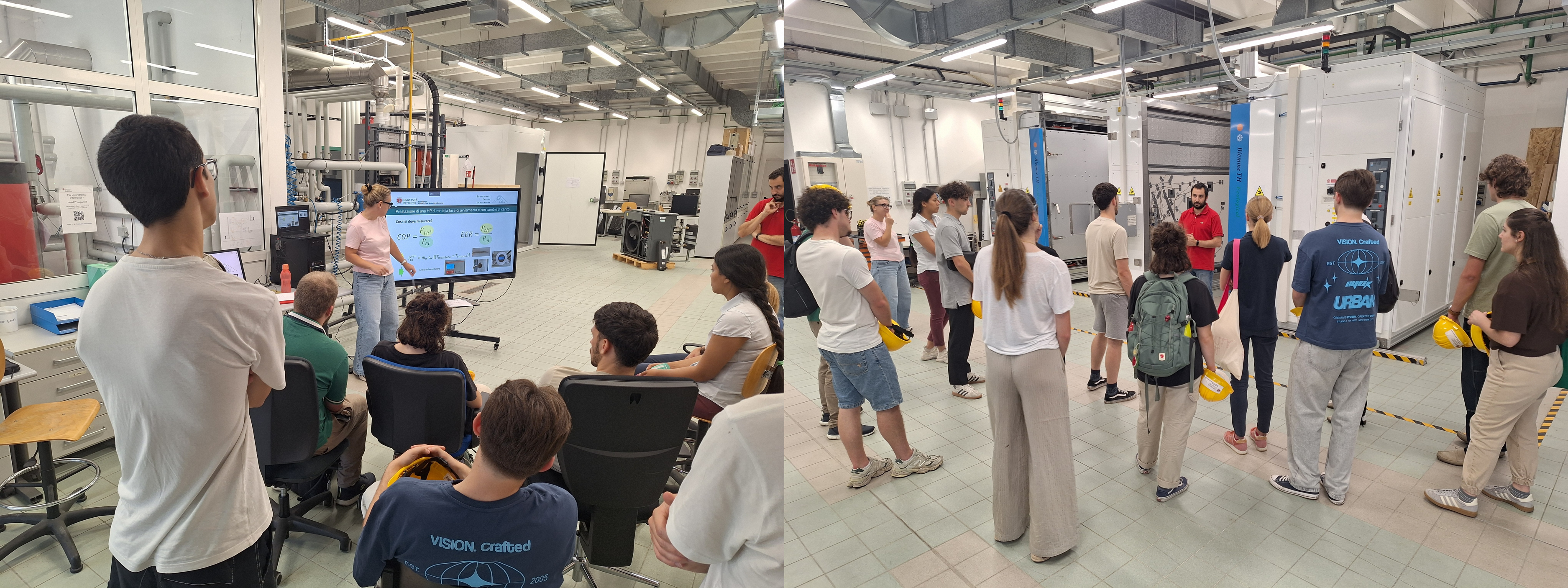
Exciting day at our laboratory hosting the Energy Engineering students from the joint UniTN/UniBZ course on HVAC Systems!
During the visit, students explored how heating and cooling systems operate in real experimental conditions, connecting theoretical concepts with ongoing research activities in the laboratory.
We presented our work on energy efficiency solutions for the opaque building envelope, with particular attention to the dynamic behavior of HVAC systems. A highlight of the visit was the performance testing of a heat pump during the start-up phase, investigating the inefficiencies that occur during transient operating conditions and their impact on overall system performance.
The experimental line is fully monitored and controlled through a LabVIEW platform, with the control code entirely developed in-house by our research team, enabling advanced automation, monitoring, and detailed analysis of system behavior.
It was a great opportunity to share our research activities and show students how real heating and cooling systems are tested and analyzed in practice.
Very exciting to welcome the next generation of energy engineers into the lab!
17/04/2026
A Hands-On Experience in the Sustainable Energy Laboratory
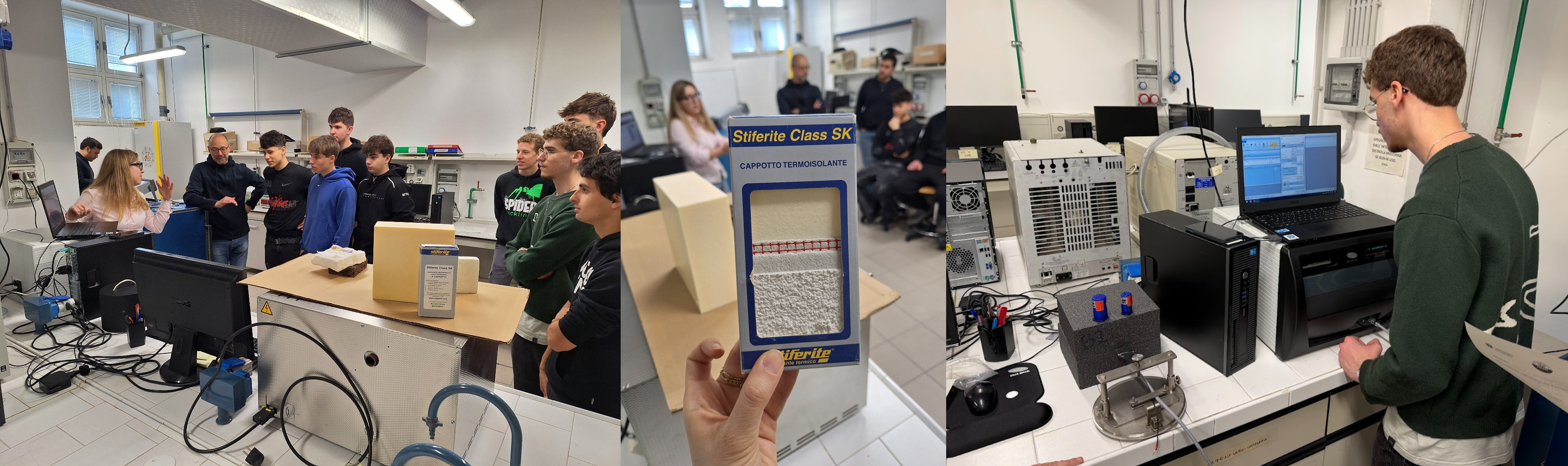
We recently hosted a group of students from ITT Marconi school in Rovereto (Energy track) in our laboratories, as part of a joint initiative involving three other labs of the Department of Civil, Environmental and Mechanical Engineering (DICAM) working in the field of energy.
During the visit, students were introduced to key topics related to energy efficiency in buildings, with a particular focus on innovative materials for the building envelope and their performance. Theoretical insights were combined with practical activities to provide a more engaging and effective learning experience.
A central part of the session was dedicated to experimental measurements using advanced equipment, including the Hot Disk instrument, which allowed students to directly assess the thermal properties of different materials.
This hands-on experience gave students the opportunity to actively engage with real experimental techniques, turning theoretical concepts into tangible results. The initiative offered a valuable opportunity to experience applied research firsthand and to explore the technologies and methods used in the development of more efficient and sustainable buildings.
15/04/2026
New Paper Published in Energy on Air-to-Water Heat Pumps in Alpine Regions under Climate Change
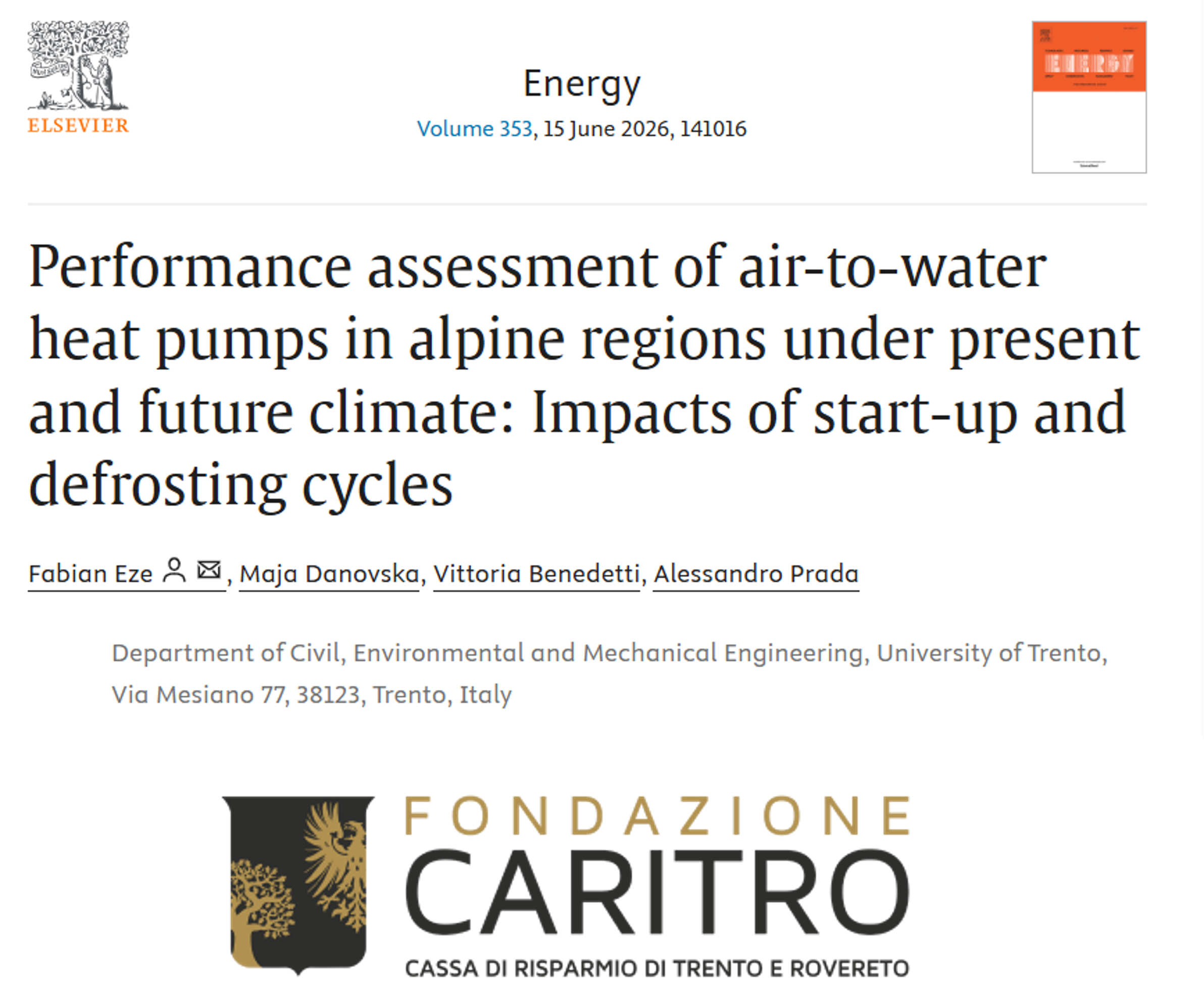
Our latest research, titled “Performance assessment of air-to-water heat pumps in alpine regions under present and future climate: Impacts of start-up and defrosting cycles,” has been published in Energy and is now available online.
This study investigates how start-up delays and defrosting cycles affect the real performance of air-to-water heat pumps (AWHPs) in Alpine regions, both under current and future climate conditions. Using an integrated TRNSYS-based modelling framework with experimentally validated degradation correlations, we assessed system performance across multiple municipalities in Northern Italy.
Key findings: start-up effects alone reduce SCOP by approximately 4–6%, while the combined impact of start-up and defrosting cycles can lead to reductions of up to 11% and increases in primary energy consumption of up to 12%. Future climate projections indicate that warming trends may improve AWHP performance, with SCOP increasing by up to 6% and primary energy consumption decreasing by up to 10% by 2050.
The results highlight the importance of explicitly modelling transient operating conditions, which are often neglected in conventional simulations, and provide insights for more accurate performance assessment and climate-resilient design of heat pump systems in mountainous regions.
This research was funded by Fondazione CARITRO (Cassa di Risparmio di Trento e Rovereto).
Read the paper:
https://doi.org/10.1016/j.energy.2026.141016
Special thanks to all co-authors for their valuable contributions in modelling, data analysis, and validation.
11/3/2026
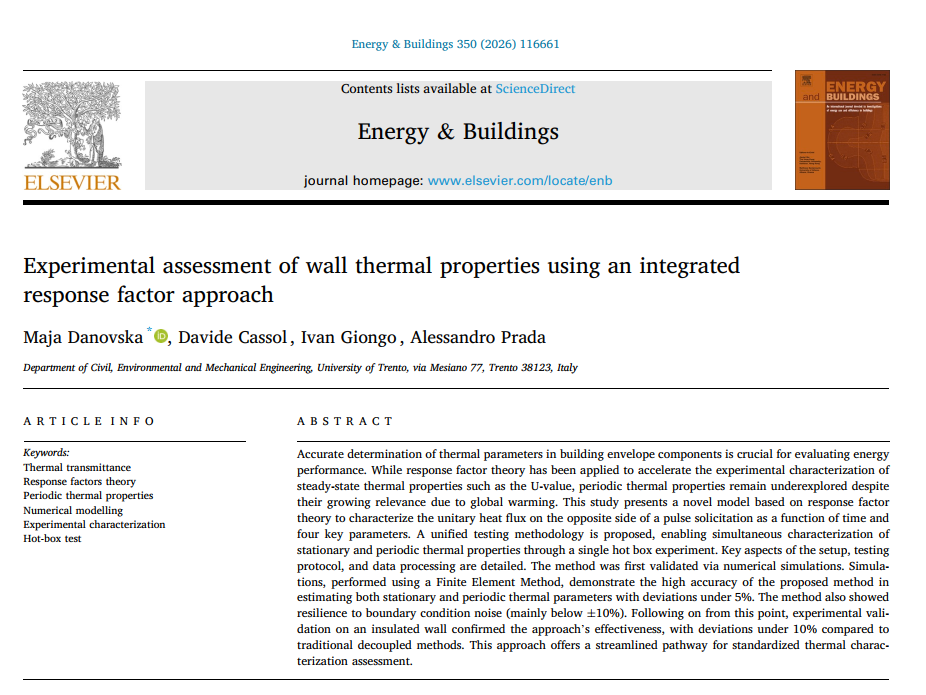
New Paper Accepted in Energy & Buildings on PCM-Based Wall Systems for Summer Thermal Management
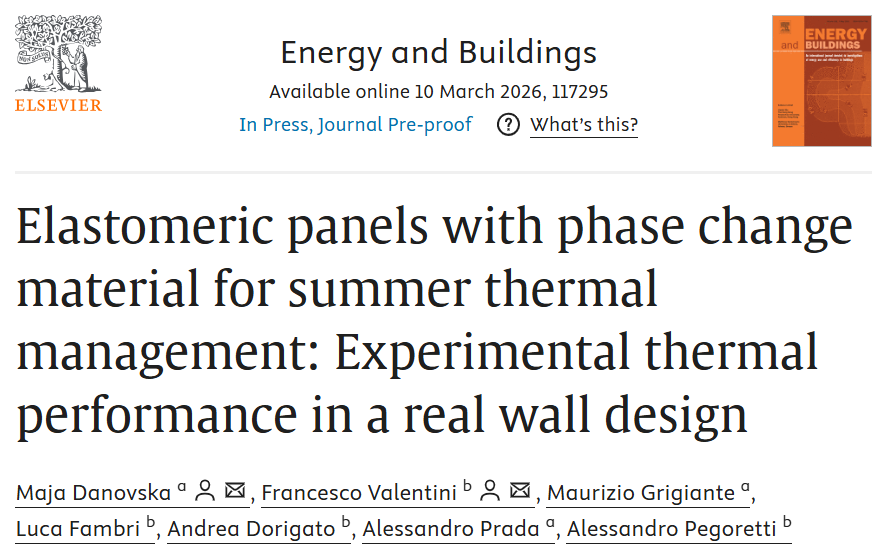
Our latest research, titled “Elastomeric panels with Phase Change Material for summer thermal management: Experimental thermal performance in a real wall design,” has just been accepted in Energy & Buildings and it is available online.
This work, carried out at the Sustainable Energy Lab of the University of Trento in collaboration with colleagues from the Department of Industrial Engineering, experimentally investigates the integration of Phase Change Materials (PCMs) into real-scale wall assemblies as a passive strategy to improve summer thermal performance. Using a double climatic chamber, we tested three wall configurations under dynamic temperature profiles representative of the climates of Trento and Palermo.
Key findings: the integration of a thin PCM layer significantly improves the dynamic thermal response of the wall by increasing its thermal inertia, delaying heat transfer, reducing heat flux peaks, and enhancing daily thermal energy storage capacity. These results show that PCM integration can effectively delay and dampen heat transfer, potentially reducing peak cooling demand and enabling smaller HVAC system sizing.
The study also highlights a crucial aspect: PCM performance strongly depends on climate conditions and on the match between the PCM melting temperature and local temperature profiles.
Beyond the technical results, the work proposes a systematic experimental methodology for evaluating PCM performance in realistic wall configurations, helping bridge the gap between laboratory studies and real building applications.
This research was partially funded by Fondazione per la Valorizzazione della Ricerca Trentina (VRT).
Read the paper:
https://lnkd.in/g3TFdFDv
Special thanks to Maja Danovska and Francesco Valentini (corresponding authors) for the valuable support in writing and data analysis; Prof. Maurizio Grigiante and Prof. Alessandro Prada for their methodological guidance; and Prof. Luca Fambri, Prof. Andrea Dorigato, and Prof. Alessandro Pegoretti for their insightful feedback during the refinement of the paper.
This research was funded by Fondazione CARITRO (Cassa di Risparmio di Trento e Rovereto).
We are also looking forward to the next step: integrating these panels into a real building prototype at the TESSLabs facility in Rovereto, a new joint infrastructure promoted by the University of Trento, Fondazione Bruno Kessler, and Trentino Sviluppo dedicated to developing and validating sustainable technologies for the built environment.
19/1/2026
Advancing Building and Energy Systems Research at TESSLabs
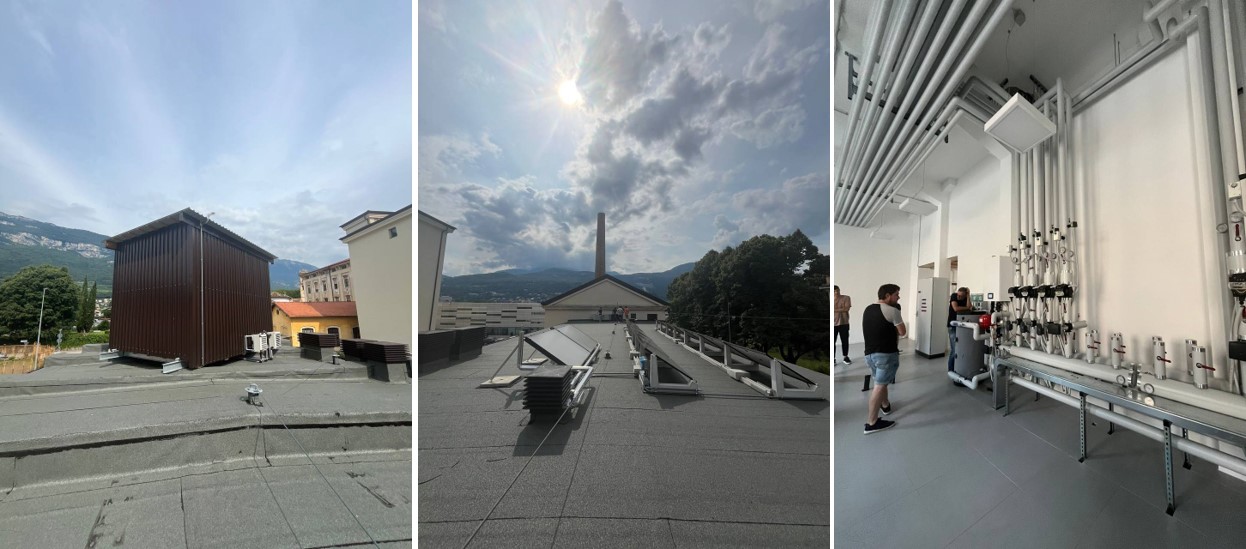
We are making significant progress within the TESSLabs in Rovereto (Trento, Italy), a research infrastructure dedicated to sustainable development, future energy systems, and quality of life, located in the green innovation hub Progetto Manifattura.
We are currently developing a new experimental module based on two PASSYS cells, enabling in-situ testing of building envelope components and the evaluation of their real operational performance. In parallel, the module allows the assessment of HVAC system performance through a fully automated and monitored heating and cooling system.
The laboratory supports research and prototyping in close collaboration with industry, focusing on advanced control strategies for heat pump systems, including integration with photovoltaic (PV) systems and battery energy storage systems (BESS), as well as dedicated studies on battery performance.
To ensure accurate monitoring, the facility is equipped with temperature and heat flux sensors for wall measurements, solar radiation sensors (global and diffuse, SPN1), and lux meters for indoor illuminance. Sensor testing and validation activities are currently ongoing.
A concrete step toward more efficient, intelligent, and energy-self-sufficient buildings.
8/1/2026
Explore our research and teaching topics in the field of energy efficiency in buildings
Energy efficiency in buildings is a cornerstone of the energy transition, as buildings
account for a large share of final energy consumption. Within the building sector,
HVAC systems represent one of the most energy-intensive components, often
responsible for a significant portion of the total energy use for heating, cooling, and
ventilation.
Improving the efficiency of HVAC systems through advanced design, control strategies, and
system integration is essential to reduce energy demand while maintaining high levels of
indoor comfort and air quality. At the same time, the widespread adoption of
renewable energy technologies, such as photovoltaic systems and renewable-based
heating and cooling solutions, plays a crucial role in lowering the environmental impact of buildings.
Producing renewable energy on-site and using it efficiently through smart energy management,
load matching, and self-consumption strategies allows buildings to move towards higher levels
of energy autonomy and sustainability. Our research and teaching activities focus on these
challenges, providing students with the knowledge and tools needed to design and operate
high-performance, energy-efficient buildings.
07/1/2026
Interested in energy-related issues in buildings? Join us and become an energy engineer!
Buildings play a central role in the global energy transition, accounting for a significant
share of energy consumption and greenhouse gas emissions. Improving building energy efficiency
is therefore a key challenge for achieving climate neutrality, reducing energy demand, and
enhancing indoor comfort.
Beyond efficiency, the transition of the building sector increasingly relies on the
electrification of energy uses and on the intelligent management of electrical energy flows.
Topics such as photovoltaic electricity generation, battery energy storage systems, self-consumption,
energy self-sufficiency, and the interaction between buildings and the electrical grid are becoming
central elements in modern building design and operation.
To address these challenges, the inter-university Master’s Degree in Energy Engineering jointly
offered by the University of Trento and the
Free University of Bozen-Bolzano provides advanced education on building energy
performance, HVAC systems, renewable energy production and integration, energy storage technologies,
and smart energy management strategies.
The programme combines solid theoretical foundations with hands-on laboratory activities,
numerical modelling, and real-world applications, preparing students to tackle complex
energy-related issues in the built environment.
Join us and become part of the next generation of energy engineers shaping the future of
high-performance, energy-autonomous, and sustainable buildings.